FocusOn Neurology
  • Biozone
  • Multiple Sclerosis
  • Migraine Research Library
  • LGS & Dravet Syndrome
  • Tardive Dyskinesia
  • Myasthenia Gravis
  • Neurofibromatosis
  • hATTR-PN
  • MDA 2024
  • CIDP Awareness Month
  • Alzheimer's Awareness Month
  • Anticoagulation Reversal Knowledge & Learning Center
  • PNS 2024 Annual Meeting Highlights
  • Parkinson's Disease
  • AES Annual Meeting 2025
  • Epilepsy Knowledge Hub
  • Stroke Awareness Month
  • Multiple Sclerosis
  • Migraine Research Library
  • LGS & Dravet Syndrome
  • Tardive Dyskinesia
  • Myasthenia Gravis
  • Neurofibromatosis
  • hATTR-PN
  • MDA 2024
  • CIDP Awareness Month
  • Alzheimer's Awareness Month
  • Anticoagulation Reversal Knowledge & Learning Center
  • PNS 2024 Annual Meeting Highlights
  • Parkinson's Disease
    • Peer-reviewed articles
    • Supplemental educational content
    • Test Your Knowledge
  • AES Annual Meeting 2025
  • Epilepsy Knowledge Hub

Advanced Search

Advanced Search

  • Featured:
  • Biozone
  • Stroke Awareness Month
 

Pill or plug? Rethinking secondary stroke prevention for PFO patients

March 2026 | Annals of Medicine & Surgery
Share:
Stroke Awareness Month Peer-Reviewed Articles Page

Read Full Article

Abstract

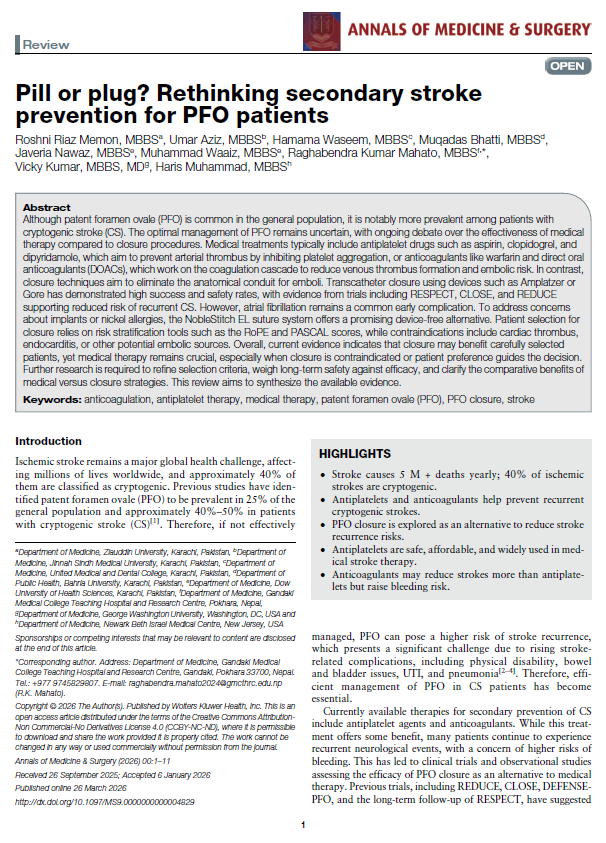
Although patent foramen ovale (PFO) is common in the general population, it is notably more prevalent among patients with cryptogenic stroke (CS). The optimal management of PFO remains uncertain, with ongoing debate over the effectiveness of medical therapy compared to closure procedures. Medical treatments typically include antiplatelet drugs such as aspirin, clopidogrel, and dipyridamole, which aim to prevent arterial thrombus by inhibiting platelet aggregation, or anticoagulants like warfarin and direct oral anticoagulants (DOACs), which work on the coagulation cascade to reduce venous thrombus formation and embolic risk. In contrast, closure techniques aim to eliminate the anatomical conduit for emboli. Transcatheter closure using devices such as Amplatzer or Gore has demonstrated high success and safety rates, with evidence from trials including RESPECT, CLOSE, and REDUCE supporting reduced risk of recurrent CS. However, atrial fibrillation remains a common early complication. To address concerns about implants or nickel allergies, the NobleStitch EL suture system offers a promising device-free alternative. Patient selection for closure relies on risk stratification tools such as the RoPE and PASCAL scores, while contraindications include cardiac thrombus, endocarditis, or other potential embolic sources. Overall, current evidence indicates that closure may benefit carefully selected patients, yet medical therapy remains crucial, especially when closure is contraindicated or patient preference guides the decision. Further research is required to refine selection criteria, weigh long-term safety against efficacy, and clarify the comparative benefits of medical versus closure strategies. This review aims to synthesize the available evidence.

Annals of Medicine and Surgery - Copyright © 2026 the Author(s). Published by Wolters Kluwer Health, Inc.

Share

Modal body text goes here.

FocusOn logo
  • Articles
  • Multimedia
  • Blog
  • Resources
  • About FocusOn
  • Privacy Policy
  • Terms of Use

© 2026 Wolters Kluwer. All right reserved.

Your Privacy

To give you the best possible experience we use cookies and similar technologies. We use data collected through these technologies for various purposes, including to enhance website functionality, remember your preferences, show the most relevant content, and show the most useful ads. You can select your preferences by clicking the link. For more information, please review our Privacy and Cookie Policy.

|
|

Cookie Policy

Information about our use of cookies

Wolters Kluwer ("we" or "us") wants to inform you about the ways we process your personal information. In this Privacy & Cookie Notice we explain what personal information we collect, use and disclose.

Personal information means any data relating to an individual who can be identified, directly or indirectly, based on that information. This may include information such as names, contact details, (online) identification data, online identifiers, or other characteristics specific to that individual.

Read More