FocusOn Neurology
  • Biozone
  • Multiple Sclerosis
  • Migraine Research Library
  • LGS & Dravet Syndrome
  • Tardive Dyskinesia
  • Myasthenia Gravis
  • Neurofibromatosis
  • hATTR-PN
  • MDA 2024
  • CIDP Awareness Month
  • Alzheimer's Awareness Month
  • Anticoagulation Reversal Knowledge & Learning Center
  • PNS 2024 Annual Meeting Highlights
  • Parkinson's Disease
  • AES Annual Meeting 2025
  • Epilepsy Awareness Month
  • Stroke Awareness Month
  • Multiple Sclerosis
  • Migraine Research Library
  • LGS & Dravet Syndrome
  • Tardive Dyskinesia
  • Myasthenia Gravis
  • Neurofibromatosis
  • hATTR-PN
  • MDA 2024
  • CIDP Awareness Month
  • Alzheimer's Awareness Month
  • Anticoagulation Reversal Knowledge & Learning Center
  • PNS 2024 Annual Meeting Highlights
  • Parkinson's Disease
    • Peer-reviewed articles
    • Supplemental educational content
    • Test Your Knowledge
  • AES Annual Meeting 2025
  • Epilepsy Awareness Month

Advanced Search

Advanced Search

  • Featured:
  • Biozone
  • Stroke Awareness Month
 

Acute vertigo: stroke or not?

February 2026 | Current Opinion in Neurology
Share:
Stroke Awareness Month Peer-Reviewed Articles Page

Read Full Article

Purpose of review 

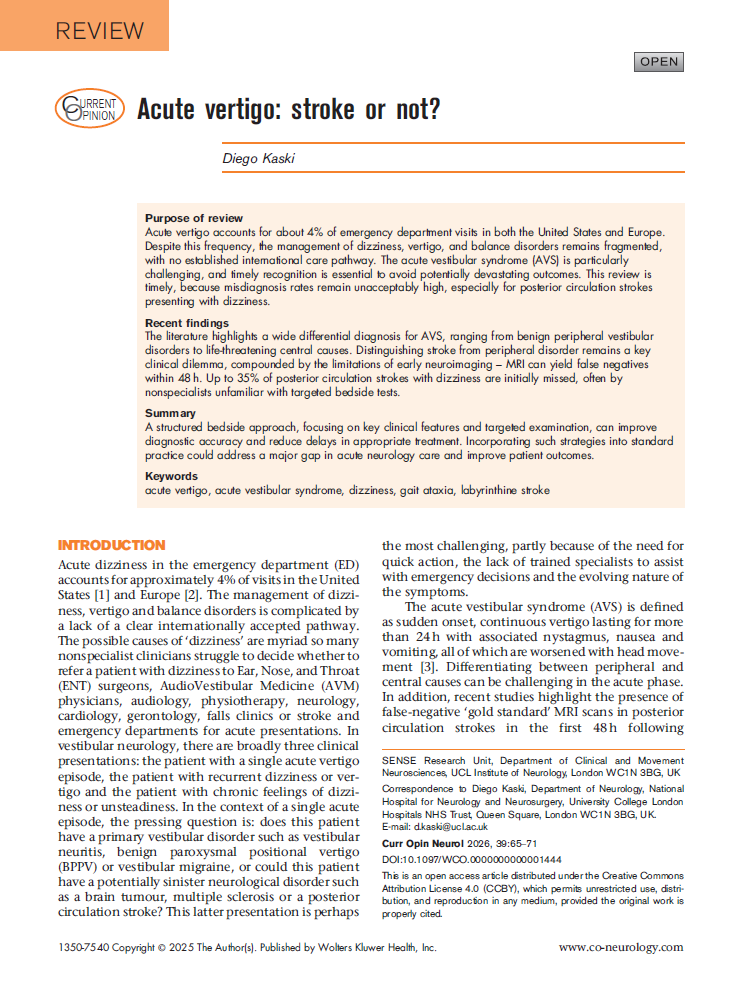
Acute vertigo accounts for about 4% of emergency department visits in both the United States and Europe. Despite this frequency, the management of dizziness, vertigo, and balance disorders remains fragmented, with no established international care pathway. The acute vestibular syndrome (AVS) is particularly challenging, and timely recognition is essential to avoid potentially devastating outcomes. This review is timely, because misdiagnosis rates remain unacceptably high, especially for posterior circulation strokes presenting with dizziness.

Recent findings 

The literature highlights a wide differential diagnosis for AVS, ranging from benign peripheral vestibular disorders to life-threatening central causes. Distinguishing stroke from peripheral disorder remains a key clinical dilemma, compounded by the limitations of early neuroimaging – MRI can yield false negatives within 48 h. Up to 35% of posterior circulation strokes with dizziness are initially missed, often by nonspecialists unfamiliar with targeted bedside tests.

Summary 

A structured bedside approach, focusing on key clinical features and targeted examination, can improve diagnostic accuracy and reduce delays in appropriate treatment. Incorporating such strategies into standard practice could address a major gap in acute neurology care and improve patient outcomes.

Current Opinion in Neurology - Copyright © 2025 The Author(s). Published by Wolters Kluwer Health, Inc.

Share

Modal body text goes here.

FocusOn logo
  • Articles
  • Multimedia
  • Blog
  • Resources
  • About FocusOn
  • Privacy Policy
  • Terms of Use

© 2026 Wolters Kluwer. All right reserved.

Your Privacy

To give you the best possible experience we use cookies and similar technologies. We use data collected through these technologies for various purposes, including to enhance website functionality, remember your preferences, show the most relevant content, and show the most useful ads. You can select your preferences by clicking the link. For more information, please review our Privacy and Cookie Policy.

|
|

Cookie Policy

Information about our use of cookies

Wolters Kluwer ("we" or "us") wants to inform you about the ways we process your personal information. In this Privacy & Cookie Notice we explain what personal information we collect, use and disclose.

Personal information means any data relating to an individual who can be identified, directly or indirectly, based on that information. This may include information such as names, contact details, (online) identification data, online identifiers, or other characteristics specific to that individual.

Read More