FocusOn Neurology
  • Biozone
  • Multiple Sclerosis
  • Migraine Research Library
  • LGS & Dravet Syndrome
  • Tardive Dyskinesia
  • Myasthenia Gravis
  • Neurofibromatosis
  • hATTR-PN
  • MDA 2024
  • CIDP Awareness Month
  • Alzheimer's Awareness Month
  • Anticoagulation Reversal Knowledge & Learning Center
  • PNS 2024 Annual Meeting Highlights
  • Parkinson's Disease
  • AES Annual Meeting 2025
  • Epilepsy Knowledge Hub
  • Stroke Awareness Month
  • Multiple Sclerosis
  • Migraine Research Library
  • LGS & Dravet Syndrome
  • Tardive Dyskinesia
  • Myasthenia Gravis
  • Neurofibromatosis
  • hATTR-PN
  • MDA 2024
  • CIDP Awareness Month
  • Alzheimer's Awareness Month
  • Anticoagulation Reversal Knowledge & Learning Center
  • PNS 2024 Annual Meeting Highlights
  • Parkinson's Disease
    • Peer-reviewed articles
    • Supplemental educational content
    • Test Your Knowledge
  • AES Annual Meeting 2025
  • Epilepsy Knowledge Hub

Advanced Search

Advanced Search

  • Featured:
  • Biozone
  • Stroke Awareness Month

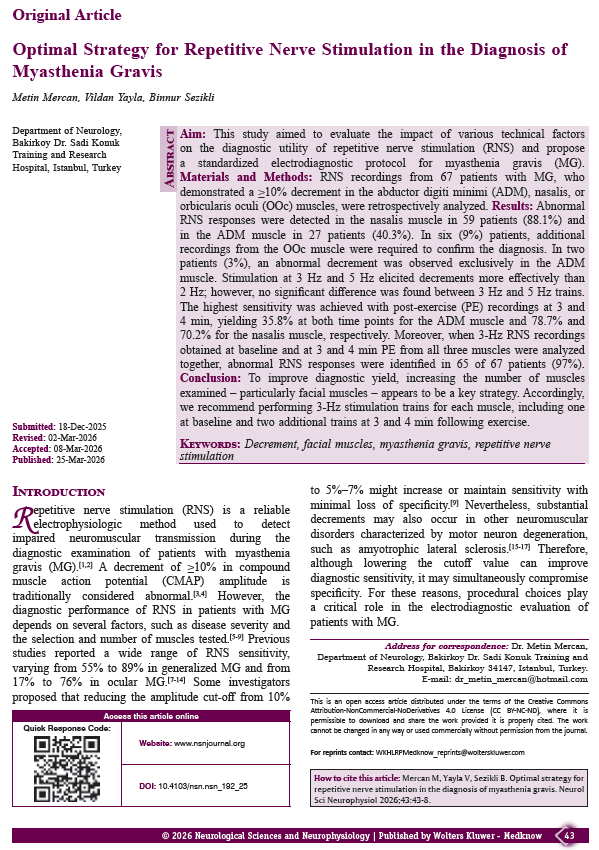
Optimal Strategy for Repetitive Nerve Stimulation in the Diagnosis of Myasthenia Gravis

March 2026
Share:
Back to Myasthenia Gravis Peer-reviewed articles

Read Full Article

Abstract

Aim: 

This study aimed to evaluate the impact of various technical factors on the diagnostic utility of repetitive nerve stimulation (RNS) and propose a standardized electrodiagnostic protocol for myasthenia gravis (MG).

Materials and Methods 

RNS recordings from 67 patients with MG, who demonstrated a ≥10% decrement in the abductor digiti minimi (ADM), nasalis, or orbicularis oculi (OOc) muscles, were retrospectively analyzed.

Results: 

Abnormal RNS responses were detected in the nasalis muscle in 59 patients (88.1%) and in the ADM muscle in 27 patients (40.3%). In six (9%) patients, additional recordings from the OOc muscle were required to confirm the diagnosis. In two patients (3%), an abnormal decrement was observed exclusively in the ADM muscle. Stimulation at 3 Hz and 5 Hz elicited decrements more effectively than 2 Hz; however, no significant difference was found between 3 Hz and 5 Hz trains. The highest sensitivity was achieved with post-exercise (PE) recordings at 3 and 4 min, yielding 35.8% at both time points for the ADM muscle and 78.7% and 70.2% for the nasalis muscle, respectively. Moreover, when 3-Hz RNS recordings obtained at baseline and at 3 and 4 min PE from all three muscles were analyzed together, abnormal RNS responses were identified in 65 of 67 patients (97%).

Conclusion: 

To improve diagnostic yield, increasing the number of muscles examined – particularly facial muscles – appears to be a key strategy. Accordingly, we recommend performing 3-Hz stimulation trains for each muscle, including one at baseline and two additional trains at 3 and 4 min following exercise.

Share

Modal body text goes here.

FocusOn logo
  • Articles
  • Multimedia
  • Blog
  • Resources
  • About FocusOn
  • Privacy Policy
  • Terms of Use

© 2026 Wolters Kluwer. All right reserved.

Your Privacy

To give you the best possible experience we use cookies and similar technologies. We use data collected through these technologies for various purposes, including to enhance website functionality, remember your preferences, show the most relevant content, and show the most useful ads. You can select your preferences by clicking the link. For more information, please review our Privacy and Cookie Policy.

|
|

Cookie Policy

Information about our use of cookies

Wolters Kluwer ("we" or "us") wants to inform you about the ways we process your personal information. In this Privacy & Cookie Notice we explain what personal information we collect, use and disclose.

Personal information means any data relating to an individual who can be identified, directly or indirectly, based on that information. This may include information such as names, contact details, (online) identification data, online identifiers, or other characteristics specific to that individual.

Read More