FocusOn Neurology
  • Biozone
  • Multiple Sclerosis
  • Migraine Research Library
  • LGS & Dravet Syndrome
  • Tardive Dyskinesia
  • Myasthenia Gravis
  • Neurofibromatosis
  • hATTR-PN
  • MDA 2024
  • CIDP Awareness Month
  • Alzheimer's Awareness Month
  • Anticoagulation Reversal Knowledge & Learning Center
  • PNS 2024 Annual Meeting Highlights
  • Parkinson's Disease
  • AES Annual Meeting 2025
  • Epilepsy Knowledge Hub
  • Stroke Awareness Month
  • Multiple Sclerosis
  • Migraine Research Library
  • LGS & Dravet Syndrome
  • Tardive Dyskinesia
  • Myasthenia Gravis
  • Neurofibromatosis
  • hATTR-PN
  • MDA 2024
  • CIDP Awareness Month
  • Alzheimer's Awareness Month
  • Anticoagulation Reversal Knowledge & Learning Center
  • PNS 2024 Annual Meeting Highlights
  • Parkinson's Disease
    • Peer-reviewed articles
    • Supplemental educational content
    • Test Your Knowledge
  • AES Annual Meeting 2025
  • Epilepsy Knowledge Hub

Advanced Search

Advanced Search

  • Featured:
  • Biozone
  • Stroke Awareness Month

Low Prevalence and Inconsistency of LRP4-IgG Detection in Suspected Myasthenia Gravis: A Multicenter CBA Comparison

May 2026
Share:
Back to Myasthenia Gravis Peer-reviewed articles

Read Full Article

Abstract

Background and Objectives

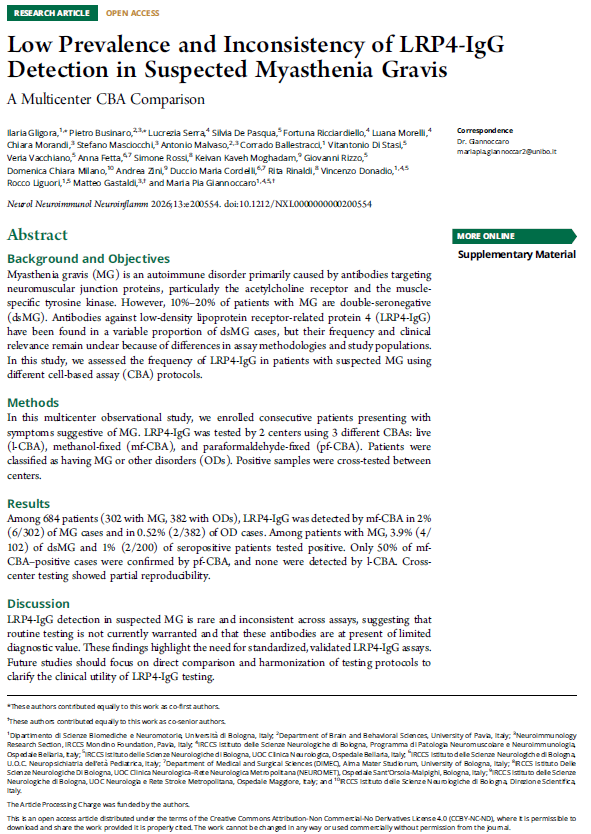
Myasthenia gravis (MG) is an autoimmune disorder primarily caused by antibodies targeting neuromuscular junction proteins, particularly the acetylcholine receptor and the muscle-specific tyrosine kinase. However, 10%–20% of patients with MG are double-seronegative (dsMG). Antibodies against low-density lipoprotein receptor-related protein 4 (LRP4-IgG) have been found in a variable proportion of dsMG cases, but their frequency and clinical relevance remain unclear because of differences in assay methodologies and study populations. In this study, we assessed the frequency of LRP4-IgG in patients with suspected MG using different cell-based assay (CBA) protocols.

Methods

In this multicenter observational study, we enrolled consecutive patients presenting with symptoms suggestive of MG. LRP4-IgG was tested by 2 centers using 3 different CBAs: live (l-CBA), methanol-fixed (mf-CBA), and paraformaldehyde-fixed (pf-CBA). Patients were classified as having MG or other disorders (ODs). Positive samples were cross-tested between centers.

Results

Among 684 patients (302 with MG, 382 with ODs), LRP4-IgG was detected by mf-CBA in 2% (6/302) of MG cases and in 0.52% (2/382) of OD cases. Among patients with MG, 3.9% (4/102) of dsMG and 1% (2/200) of seropositive patients tested positive. Only 50% of mf-CBA–positive cases were confirmed by pf-CBA, and none were detected by l-CBA. Cross-center testing showed partial reproducibility.

Discussion

LRP4-IgG detection in suspected MG is rare and inconsistent across assays, suggesting that routine testing is not currently warranted and that these antibodies are at present of limited diagnostic value. These findings highlight the need for standardized, validated LRP4-IgG assays. Future studies should focus on direct comparison and harmonization of testing protocols to clarify the clinical utility of LRP4-IgG testing.

Share

Modal body text goes here.

FocusOn logo
  • Articles
  • Multimedia
  • Blog
  • Resources
  • About FocusOn
  • Privacy Policy
  • Terms of Use

© 2026 Wolters Kluwer. All right reserved.

Your Privacy

To give you the best possible experience we use cookies and similar technologies. We use data collected through these technologies for various purposes, including to enhance website functionality, remember your preferences, show the most relevant content, and show the most useful ads. You can select your preferences by clicking the link. For more information, please review our Privacy and Cookie Policy.

|
|

Cookie Policy

Information about our use of cookies

Wolters Kluwer ("we" or "us") wants to inform you about the ways we process your personal information. In this Privacy & Cookie Notice we explain what personal information we collect, use and disclose.

Personal information means any data relating to an individual who can be identified, directly or indirectly, based on that information. This may include information such as names, contact details, (online) identification data, online identifiers, or other characteristics specific to that individual.

Read More