FocusOn Neurology
  • Biozone
  • Multiple Sclerosis
  • Migraine Research Library
  • LGS & Dravet Syndrome
  • Tardive Dyskinesia
  • Myasthenia Gravis
  • Neurofibromatosis
  • hATTR-PN
  • MDA 2024
  • CIDP Awareness Month
  • Alzheimer's Awareness Month
  • Anticoagulation Reversal Knowledge & Learning Center
  • PNS 2024 Annual Meeting Highlights
  • Parkinson's Disease
  • AES Annual Meeting 2025
  • Epilepsy Knowledge Hub
  • Stroke Awareness Month
  • Multiple Sclerosis
  • Migraine Research Library
  • LGS & Dravet Syndrome
  • Tardive Dyskinesia
  • Myasthenia Gravis
  • Neurofibromatosis
  • hATTR-PN
  • MDA 2024
  • CIDP Awareness Month
  • Alzheimer's Awareness Month
  • Anticoagulation Reversal Knowledge & Learning Center
  • PNS 2024 Annual Meeting Highlights
  • Parkinson's Disease
    • Peer-reviewed articles
    • Supplemental educational content
    • Test Your Knowledge
  • AES Annual Meeting 2025
  • Epilepsy Knowledge Hub

Advanced Search

Advanced Search

  • Featured:
  • Biozone
  • Stroke Awareness Month
 

Diagnosis and follow-up of a PCDH19 epilepsy patient

March 2026 | Psychiatric Genetics
Share:
Epilepsy Awareness Month Peer-Reviewed Articles Page

Read Full Article

Objective 

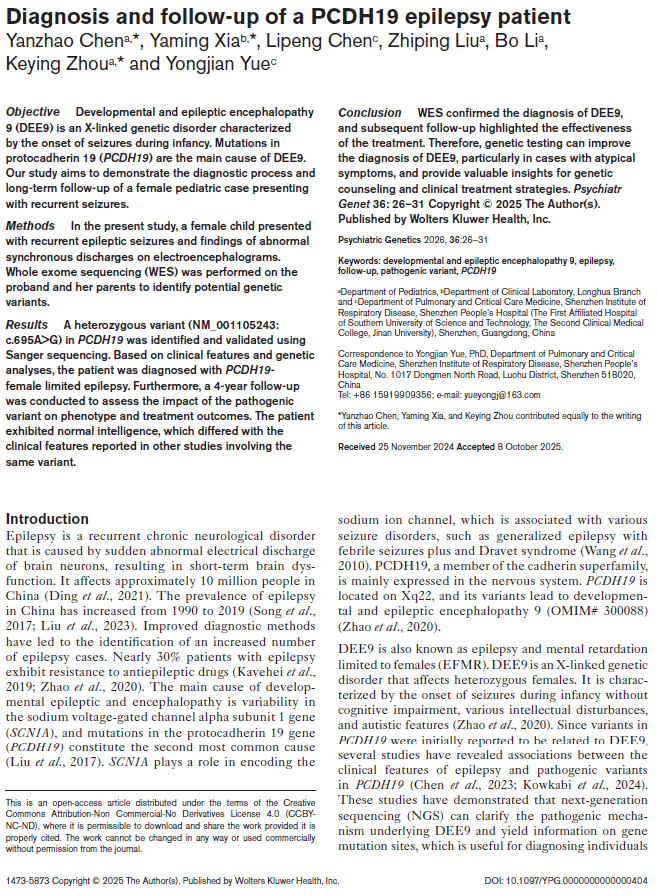
Developmental and epileptic encephalopathy 9 (DEE9) is an X-linked genetic disorder characterized by the onset of seizures during infancy. Mutations in protocadherin 19 (PCDH19) are the main cause of DEE9. Our study aims to demonstrate the diagnostic process and long-term follow-up of a female pediatric case presenting with recurrent seizures.

Methods 

In the present study, a female child presented with recurrent epileptic seizures and findings of abnormal synchronous discharges on electroencephalograms. Whole exome sequencing (WES) was performed on the proband and her parents to identify potential genetic variants.

Results 

A heterozygous variant (NM_001105243: c.695A>G) in PCDH19 was identified and validated using Sanger sequencing. Based on clinical features and genetic analyses, the patient was diagnosed with PCDH19-female limited epilepsy. Furthermore, a 4-year follow-up was conducted to assess the impact of the pathogenic variant on phenotype and treatment outcomes. The patient exhibited normal intelligence, which differed with the clinical features reported in other studies involving the same variant.

Conclusion 

WES confirmed the diagnosis of DEE9, and subsequent follow-up highlighted the effectiveness of the treatment. Therefore, genetic testing can improve the diagnosis of DEE9, particularly in cases with atypical symptoms, and provide valuable insights for genetic counseling and clinical treatment strategies.

Share

Modal body text goes here.

FocusOn logo
  • Articles
  • Multimedia
  • Blog
  • Resources
  • About FocusOn
  • Privacy Policy
  • Terms of Use

© 2026 Wolters Kluwer. All right reserved.

Your Privacy

To give you the best possible experience we use cookies and similar technologies. We use data collected through these technologies for various purposes, including to enhance website functionality, remember your preferences, show the most relevant content, and show the most useful ads. You can select your preferences by clicking the link. For more information, please review our Privacy and Cookie Policy.

|
|

Cookie Policy

Information about our use of cookies

Wolters Kluwer ("we" or "us") wants to inform you about the ways we process your personal information. In this Privacy & Cookie Notice we explain what personal information we collect, use and disclose.

Personal information means any data relating to an individual who can be identified, directly or indirectly, based on that information. This may include information such as names, contact details, (online) identification data, online identifiers, or other characteristics specific to that individual.

Read More