FocusOn Neurology
  • Biozone
  • Multiple Sclerosis
  • Migraine Research Library
  • LGS & Dravet Syndrome
  • Tardive Dyskinesia
  • Myasthenia Gravis
  • Neurofibromatosis
  • hATTR-PN
  • MDA 2024
  • CIDP Awareness Month
  • Alzheimer's Awareness Month
  • Anticoagulation Reversal Knowledge & Learning Center
  • PNS 2024 Annual Meeting Highlights
  • Parkinson's Disease
  • AES Annual Meeting 2025
  • Epilepsy Knowledge Hub
  • Stroke Awareness Month
  • Multiple Sclerosis
  • Migraine Research Library
  • LGS & Dravet Syndrome
  • Tardive Dyskinesia
  • Myasthenia Gravis
  • Neurofibromatosis
  • hATTR-PN
  • MDA 2024
  • CIDP Awareness Month
  • Alzheimer's Awareness Month
  • Anticoagulation Reversal Knowledge & Learning Center
  • PNS 2024 Annual Meeting Highlights
  • Parkinson's Disease
    • Peer-reviewed articles
    • Supplemental educational content
    • Test Your Knowledge
  • AES Annual Meeting 2025
  • Epilepsy Knowledge Hub

Advanced Search

Advanced Search

  • Featured:
  • Biozone
  • Stroke Awareness Month
 

Sleep-Related Breathing Disorders in Children with Epilepsy: Prevalence and Risk Factors

March-April 2026 | Annals of Indian Academy of Neurology
Share:
Epilepsy Awareness Month Peer-Reviewed Articles Page

Read Full Article

Abstract

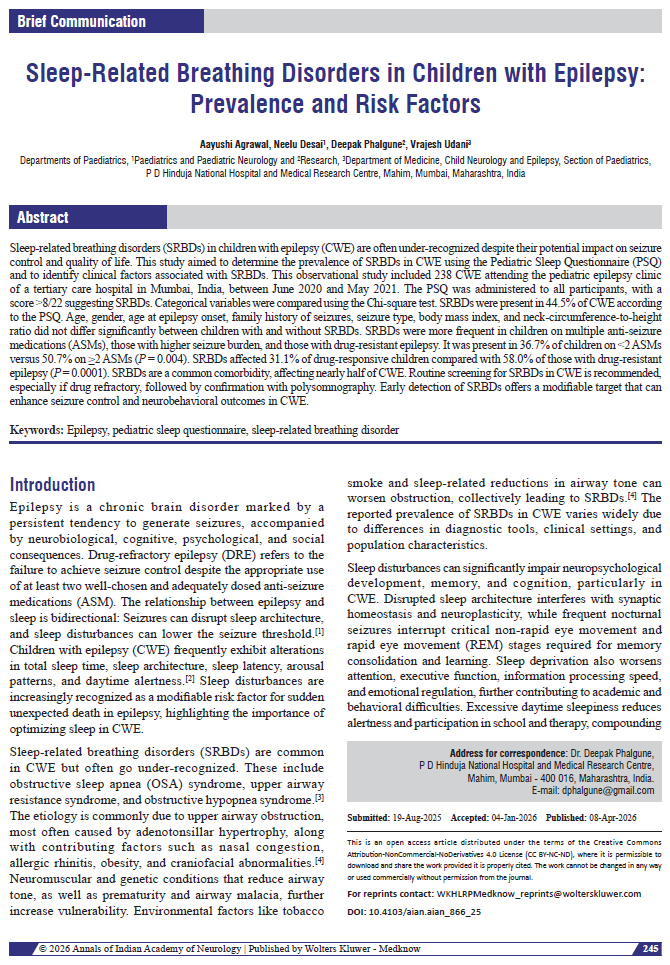
Sleep-related breathing disorders (SRBDs) in children with epilepsy (CWE) are often under-recognized despite their potential impact on seizure control and quality of life. This study aimed to determine the prevalence of SRBDs in CWE using the Pediatric Sleep Questionnaire (PSQ) and to identify clinical factors associated with SRBDs. This observational study included 238 CWE attending the pediatric epilepsy clinic of a tertiary care hospital in Mumbai, India, between June 2020 and May 2021. The PSQ was administered to all participants, with a score >8/22 suggesting SRBDs. Categorical variables were compared using the Chi-square test. SRBDs were present in 44.5% of CWE according to the PSQ. Age, gender, age at epilepsy onset, family history of seizures, seizure type, body mass index, and neck-circumference-to-height ratio did not differ significantly between children with and without SRBDs. SRBDs were more frequent in children on multiple anti-seizure medications (ASMs), those with higher seizure burden, and those with drug-resistant epilepsy. It was present in 36.7% of children on <2 ASMs versus 50.7% on ≥2 ASMs (P = 0.004). SRBDs affected 31.1% of drug-responsive children compared with 58.0% of those with drug-resistant epilepsy (P = 0.0001). SRBDs are a common comorbidity, affecting nearly half of CWE. Routine screening for SRBDs in CWE is recommended, especially if drug refractory, followed by confirmation with polysomnography. Early detection of SRBDs offers a modifiable target that can enhance seizure control and neurobehavioral outcomes in CWE.

Share

Modal body text goes here.

FocusOn logo
  • Articles
  • Multimedia
  • Blog
  • Resources
  • About FocusOn
  • Privacy Policy
  • Terms of Use

© 2026 Wolters Kluwer. All right reserved.

Your Privacy

To give you the best possible experience we use cookies and similar technologies. We use data collected through these technologies for various purposes, including to enhance website functionality, remember your preferences, show the most relevant content, and show the most useful ads. You can select your preferences by clicking the link. For more information, please review our Privacy and Cookie Policy.

|
|

Cookie Policy

Information about our use of cookies

Wolters Kluwer ("we" or "us") wants to inform you about the ways we process your personal information. In this Privacy & Cookie Notice we explain what personal information we collect, use and disclose.

Personal information means any data relating to an individual who can be identified, directly or indirectly, based on that information. This may include information such as names, contact details, (online) identification data, online identifiers, or other characteristics specific to that individual.

Read More