FocusOn Neurology
  • Biozone
  • Multiple Sclerosis
  • Migraine Research Library
  • LGS & Dravet Syndrome
  • Tardive Dyskinesia
  • Myasthenia Gravis
  • Neurofibromatosis
  • hATTR-PN
  • MDA 2024
  • CIDP Awareness Month
  • Alzheimer's Awareness Month
  • Anticoagulation Reversal Knowledge & Learning Center
  • PNS 2024 Annual Meeting Highlights
  • Parkinson's Disease
  • AES Annual Meeting 2025
  • Epilepsy Knowledge Hub
  • Stroke Awareness Month
  • Multiple Sclerosis
  • Migraine Research Library
  • LGS & Dravet Syndrome
  • Tardive Dyskinesia
  • Myasthenia Gravis
  • Neurofibromatosis
  • hATTR-PN
  • MDA 2024
  • CIDP Awareness Month
  • Alzheimer's Awareness Month
  • Anticoagulation Reversal Knowledge & Learning Center
  • PNS 2024 Annual Meeting Highlights
  • Parkinson's Disease
    • Peer-reviewed articles
    • Supplemental educational content
    • Test Your Knowledge
  • AES Annual Meeting 2025
  • Epilepsy Knowledge Hub

Advanced Search

Advanced Search

  • Featured:
  • Biozone
  • Stroke Awareness Month
 

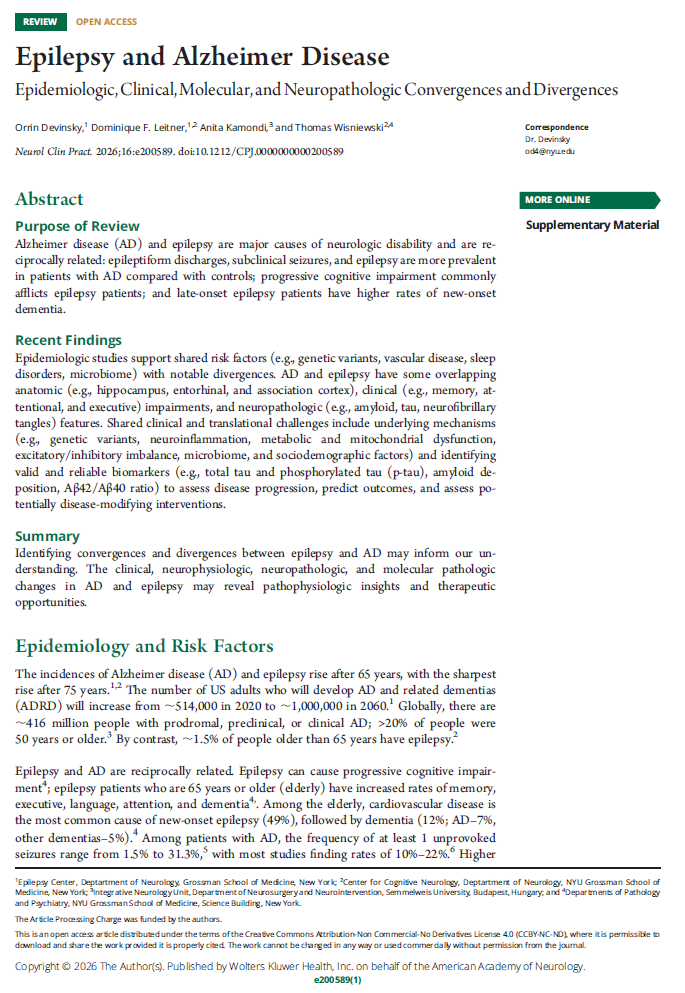
Epilepsy and Alzheimer Disease: Epidemiologic, Clinical, Molecular, and Neuropathologic Convergences and Divergences

April 2026 | Neurology: Clinical Practice
Share:
Epilepsy Awareness Month Peer-Reviewed Articles Page

Read Full Article

Abstract

Purpose of Review

Alzheimer disease (AD) and epilepsy are major causes of neurologic disability and are reciprocally related: epileptiform discharges, subclinical seizures, and epilepsy are more prevalent in patients with AD compared with controls; progressive cognitive impairment commonly afflicts epilepsy patients; and late-onset epilepsy patients have higher rates of new-onset dementia.

Recent Findings

Epidemiologic studies support shared risk factors (e.g., genetic variants, vascular disease, sleep disorders, microbiome) with notable divergences. AD and epilepsy have some overlapping anatomic (e.g., hippocampus, entorhinal, and association cortex), clinical (e.g., memory, attentional, and executive) impairments, and neuropathologic (e.g., amyloid, tau, neurofibrillary tangles) features. Shared clinical and translational challenges include underlying mechanisms (e.g., genetic variants, neuroinflammation, metabolic and mitochondrial dysfunction, excitatory/inhibitory imbalance, microbiome, and sociodemographic factors) and identifying valid and reliable biomarkers (e.g., total tau and phosphorylated tau (p-tau), amyloid deposition, Aβ42/Aβ40 ratio) to assess disease progression, predict outcomes, and assess potentially disease-modifying interventions.

Summary

Identifying convergences and divergences between epilepsy and AD may inform our understanding. The clinical, neurophysiologic, neuropathologic, and molecular pathologic changes in AD and epilepsy may reveal pathophysiologic insights and therapeutic opportunities.

Share

Modal body text goes here.

FocusOn logo
  • Articles
  • Multimedia
  • Blog
  • Resources
  • About FocusOn
  • Privacy Policy
  • Terms of Use

© 2026 Wolters Kluwer. All right reserved.

Your Privacy

To give you the best possible experience we use cookies and similar technologies. We use data collected through these technologies for various purposes, including to enhance website functionality, remember your preferences, show the most relevant content, and show the most useful ads. You can select your preferences by clicking the link. For more information, please review our Privacy and Cookie Policy.

|
|

Cookie Policy

Information about our use of cookies

Wolters Kluwer ("we" or "us") wants to inform you about the ways we process your personal information. In this Privacy & Cookie Notice we explain what personal information we collect, use and disclose.

Personal information means any data relating to an individual who can be identified, directly or indirectly, based on that information. This may include information such as names, contact details, (online) identification data, online identifiers, or other characteristics specific to that individual.

Read More