FocusOn Neurology
  • Multiple Sclerosis
  • Migraine Research Library
  • LGS & Dravet Syndrome
  • Tardive Dyskinesia
  • Myasthenia Gravis
  • Neurofibromatosis
  • hATTR-PN
  • MDA 2024
  • CIDP Awareness Month
  • Alzheimer's Awareness Month
  • Anticoagulation Reversal Knowledge & Learning Center
  • PNS 2024 Annual Meeting Highlights
  • Parkinson's Disease
  • AES Annual Meeting 2025
  • Epilepsy Knowledge Hub
  • Stroke Awareness Month
  • Rett Syndrome Awareness Month
  • Multiple Sclerosis
  • Migraine Research Library
  • LGS & Dravet Syndrome
  • Tardive Dyskinesia
  • Neurofibromatosis
  • hATTR-PN
  • MDA 2024
  • CIDP Awareness Month
  • Alzheimer's Awareness Month
  • Anticoagulation Reversal Knowledge & Learning Center
  • PNS 2024 Annual Meeting Highlights
  • Parkinson's Disease
    • Peer-reviewed articles
    • Supplemental educational content
    • Test Your Knowledge
  • AES Annual Meeting 2025
  • Epilepsy Knowledge Hub
  • Stroke Awareness Month

Advanced Search

Advanced Search

  • Featured:
  • Myasthenia Gravis
  • Rett Syndrome Awareness Month
 

Gait Analysis in Rett Syndrome: Integrating Linear and Nonlinear Techniques

May 2026 | Journal of Child Neurology
Share:
Rett Syndrome Awareness Month Peer-Reviewed Articles Page

Read Full Article

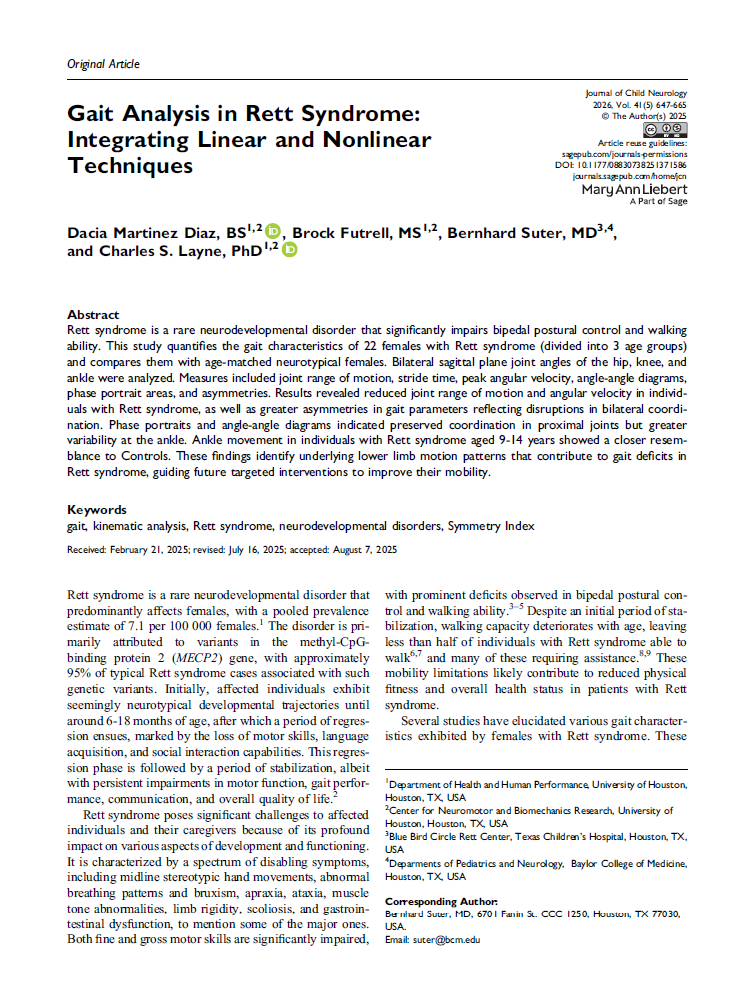
Rett syndrome is a rare neurodevelopmental disorder that significantly impairs bipedal postural control and walking ability. This study quantifies the gait characteristics of 22 females with Rett syndrome (divided into 3 age groups) and compares them with age-matched neurotypical females. Bilateral sagittal plane joint angles of the hip, knee, and ankle were analyzed. Measures included joint range of motion, stride time, peak angular velocity, angle-angle diagrams, phase portrait areas, and asymmetries. Results revealed reduced joint range of motion and angular velocity in individuals with Rett syndrome, as well as greater asymmetries in gait parameters reflecting disruptions in bilateral coordination. Phase portraits and angle-angle diagrams indicated preserved coordination in proximal joints but greater variability at the ankle. Ankle movement in individuals with Rett syndrome aged 9-14 years showed a closer resemblance to Controls. These findings identify underlying lower limb motion patterns that contribute to gait deficits in Rett syndrome, guiding future targeted interventions to improve their mobility.

Share

Modal body text goes here.

FocusOn logo
  • Articles
  • Multimedia
  • Blog
  • Resources
  • About FocusOn
  • Privacy Policy
  • Terms of Use

© 2026 Wolters Kluwer. All right reserved.