FocusOn Neurology
  • Multiple Sclerosis
  • Migraine Research Library
  • LGS & Dravet Syndrome
  • Tardive Dyskinesia
  • Myasthenia Gravis
  • Neurofibromatosis
  • hATTR-PN
  • MDA 2024
  • CIDP Awareness Month
  • Alzheimer's Awareness Month
  • Anticoagulation Reversal Knowledge & Learning Center
  • PNS 2024 Annual Meeting Highlights
  • Parkinson's Disease
  • AES Annual Meeting 2025
  • Epilepsy Knowledge Hub
  • Stroke Awareness Month
  • Multiple Sclerosis
  • Migraine Research Library
  • LGS & Dravet Syndrome
  • Tardive Dyskinesia
  • Myasthenia Gravis
  • Neurofibromatosis
  • hATTR-PN
  • MDA 2024
  • CIDP Awareness Month
  • Alzheimer's Awareness Month
  • Anticoagulation Reversal Knowledge & Learning Center
  • PNS 2024 Annual Meeting Highlights
  • Parkinson's Disease
    • Peer-reviewed articles
    • Supplemental educational content
    • Test Your Knowledge
  • AES Annual Meeting 2025
  • Stroke Awareness Month

Advanced Search

Advanced Search

  • Featured:
  • Epilepsy Knowledge Hub

Women and Myasthenia Gravis

June 2026
Back to Myasthenia Gravis Peer-reviewed articles

Read Full Article

Abstract

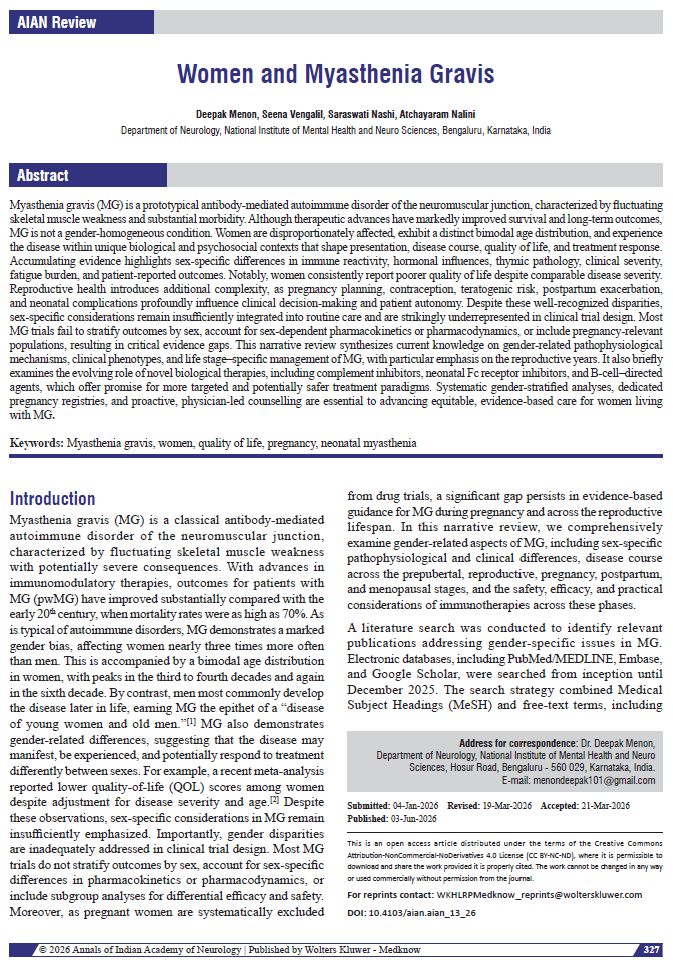
Myasthenia gravis (MG) is a prototypical antibody-mediated autoimmune disorder of the neuromuscular junction, characterized by fluctuating skeletal muscle weakness and substantial morbidity. Although therapeutic advances have markedly improved survival and long-term outcomes, MG is not a gender-homogeneous condition. Women are disproportionately affected, exhibit a distinct bimodal age distribution, and experience the disease within unique biological and psychosocial contexts that shape presentation, disease course, quality of life, and treatment response. Accumulating evidence highlights sex-specific differences in immune reactivity, hormonal influences, thymic pathology, clinical severity, fatigue burden, and patient-reported outcomes. Notably, women consistently report poorer quality of life despite comparable disease severity. Reproductive health introduces additional complexity, as pregnancy planning, contraception, teratogenic risk, postpartum exacerbation, and neonatal complications profoundly influence clinical decision-making and patient autonomy. Despite these well-recognized disparities, sex-specific considerations remain insufficiently integrated into routine care and are strikingly underrepresented in clinical trial design. Most MG trials fail to stratify outcomes by sex, account for sex-dependent pharmacokinetics or pharmacodynamics, or include pregnancy-relevant populations, resulting in critical evidence gaps. This narrative review synthesizes current knowledge on gender-related pathophysiological mechanisms, clinical phenotypes, and life stage–specific management of MG, with particular emphasis on the reproductive years. It also briefly examines the evolving role of novel biological therapies, including complement inhibitors, neonatal Fc receptor inhibitors, and B-cell–directed agents, which offer promise for more targeted and potentially safer treatment paradigms. Systematic gender-stratified analyses, dedicated pregnancy registries, and proactive, physician-led counselling are essential to advancing equitable, evidence-based care for women living with MG.

Share

Modal body text goes here.

FocusOn logo
  • Articles
  • Multimedia
  • Blog
  • Resources
  • About FocusOn
  • Privacy Policy
  • Terms of Use

© 2026 Wolters Kluwer. All right reserved.

Your Privacy

To give you the best possible experience we use cookies and similar technologies. We use data collected through these technologies for various purposes, including to enhance website functionality, remember your preferences, show the most relevant content, and show the most useful ads. You can select your preferences by clicking the link. For more information, please review our Privacy and Cookie Policy.

|
|

Cookie Policy

Information about our use of cookies

Wolters Kluwer ("we" or "us") wants to inform you about the ways we process your personal information. In this Privacy & Cookie Notice we explain what personal information we collect, use and disclose.

Personal information means any data relating to an individual who can be identified, directly or indirectly, based on that information. This may include information such as names, contact details, (online) identification data, online identifiers, or other characteristics specific to that individual.

Read More