FocusOn Neurology
  • Multiple Sclerosis
  • Migraine Research Library
  • LGS & Dravet Syndrome
  • Tardive Dyskinesia
  • Myasthenia Gravis
  • Neurofibromatosis
  • hATTR-PN
  • MDA 2024
  • CIDP Awareness Month
  • Alzheimer's Awareness Month
  • Anticoagulation Reversal Knowledge & Learning Center
  • PNS 2024 Annual Meeting Highlights
  • Parkinson's Disease
  • AES Annual Meeting 2025
  • Epilepsy Knowledge Hub
  • Stroke Awareness Month
  • Multiple Sclerosis
  • Migraine Research Library
  • LGS & Dravet Syndrome
  • Tardive Dyskinesia
  • Myasthenia Gravis
  • Neurofibromatosis
  • hATTR-PN
  • MDA 2024
  • CIDP Awareness Month
  • Alzheimer's Awareness Month
  • Anticoagulation Reversal Knowledge & Learning Center
  • PNS 2024 Annual Meeting Highlights
  • Parkinson's Disease
    • Peer-reviewed articles
    • Supplemental educational content
    • Test Your Knowledge
  • AES Annual Meeting 2025
  • Stroke Awareness Month

Advanced Search

Advanced Search

  • Featured:
  • Epilepsy Knowledge Hub

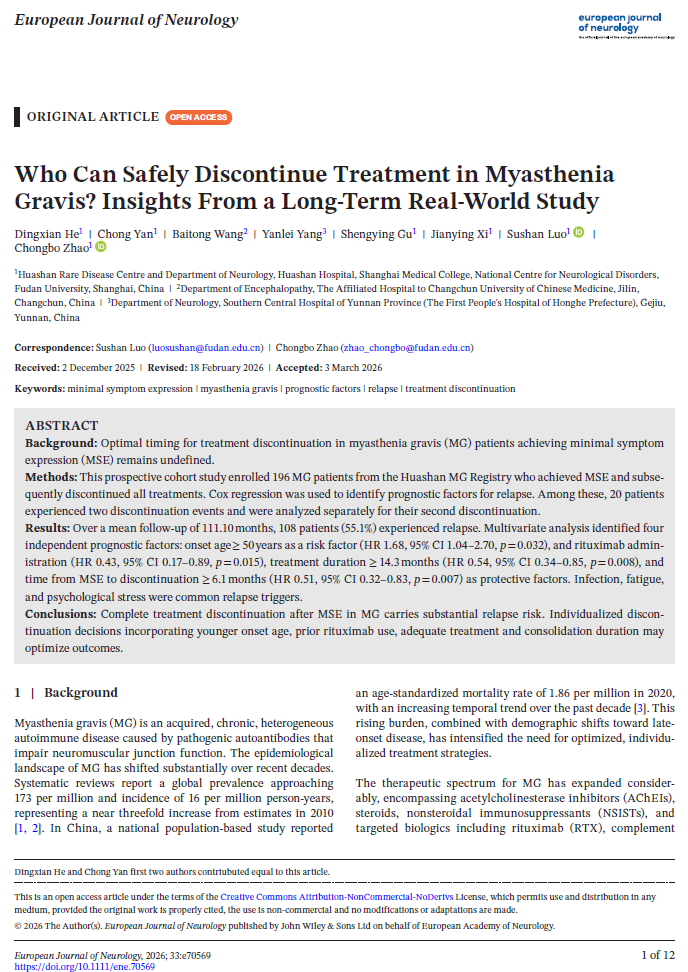
Who Can Safely Discontinue Treatment in Myasthenia Gravis? Insights From a Long-Term Real-World Study

March 2026
Back to Myasthenia Gravis Peer-reviewed articles

Read Full Article

Background

Optimal timing for treatment discontinuation in myasthenia gravis (MG) patients achieving minimal symptom expression (MSE) remains undefined.

Methods

This prospective cohort study enrolled 196 MG patients from the Huashan MG Registry who achieved MSE and subsequently discontinued all treatments. Cox regression was used to identify prognostic factors for relapse. Among these, 20 patients experienced two discontinuation events and were analyzed separately for their second discontinuation.

Results

Over a mean follow-up of 111.10 months, 108 patients (55.1%) experienced relapse. Multivariate analysis identified four independent prognostic factors: onset age ≥ 50 years as a risk factor (HR 1.68, 95% CI 1.04–2.70, p = 0.032), and rituximab administration (HR 0.43, 95% CI 0.17–0.89, p = 0.015), treatment duration ≥ 14.3 months (HR 0.54, 95% CI 0.34–0.85, p = 0.008), and time from MSE to discontinuation ≥ 6.1 months (HR 0.51, 95% CI 0.32–0.83, p = 0.007) as protective factors. Infection, fatigue, and psychological stress were common relapse triggers.

Conclusions

Complete treatment discontinuation after MSE in MG carries substantial relapse risk. Individualized discontinuation decisions incorporating younger onset age, prior rituximab use, adequate treatment and consolidation duration may optimize outcomes.

Share

Modal body text goes here.

FocusOn logo
  • Articles
  • Multimedia
  • Blog
  • Resources
  • About FocusOn
  • Privacy Policy
  • Terms of Use

© 2026 Wolters Kluwer. All right reserved.

Your Privacy

To give you the best possible experience we use cookies and similar technologies. We use data collected through these technologies for various purposes, including to enhance website functionality, remember your preferences, show the most relevant content, and show the most useful ads. You can select your preferences by clicking the link. For more information, please review our Privacy and Cookie Policy.

|
|

Cookie Policy

Information about our use of cookies

Wolters Kluwer ("we" or "us") wants to inform you about the ways we process your personal information. In this Privacy & Cookie Notice we explain what personal information we collect, use and disclose.

Personal information means any data relating to an individual who can be identified, directly or indirectly, based on that information. This may include information such as names, contact details, (online) identification data, online identifiers, or other characteristics specific to that individual.

Read More