FocusOn Neurology
  • Multiple Sclerosis
  • Migraine Research Library
  • LGS & Dravet Syndrome
  • Tardive Dyskinesia
  • Myasthenia Gravis
  • Neurofibromatosis
  • hATTR-PN
  • MDA 2024
  • CIDP Awareness Month
  • Alzheimer's Awareness Month
  • Anticoagulation Reversal Knowledge & Learning Center
  • PNS 2024 Annual Meeting Highlights
  • Parkinson's Disease
  • AES Annual Meeting 2025
  • Epilepsy Knowledge Hub
  • Stroke Awareness Month
  • Multiple Sclerosis
  • Migraine Research Library
  • LGS & Dravet Syndrome
  • Tardive Dyskinesia
  • Myasthenia Gravis
  • Neurofibromatosis
  • hATTR-PN
  • MDA 2024
  • CIDP Awareness Month
  • Alzheimer's Awareness Month
  • Anticoagulation Reversal Knowledge & Learning Center
  • PNS 2024 Annual Meeting Highlights
  • Parkinson's Disease
    • Peer-reviewed articles
    • Supplemental educational content
    • Test Your Knowledge
  • AES Annual Meeting 2025
  • Stroke Awareness Month

Advanced Search

Advanced Search

  • Featured:
  • Epilepsy Knowledge Hub
 

The 15-Year Evolution of an Epilepsy Monitoring Unit Program

July-August 2026 | Journal of Neuroscience Nursing
Share:
Epilepsy Awareness Month Peer-Reviewed Articles Page

Read Full Article

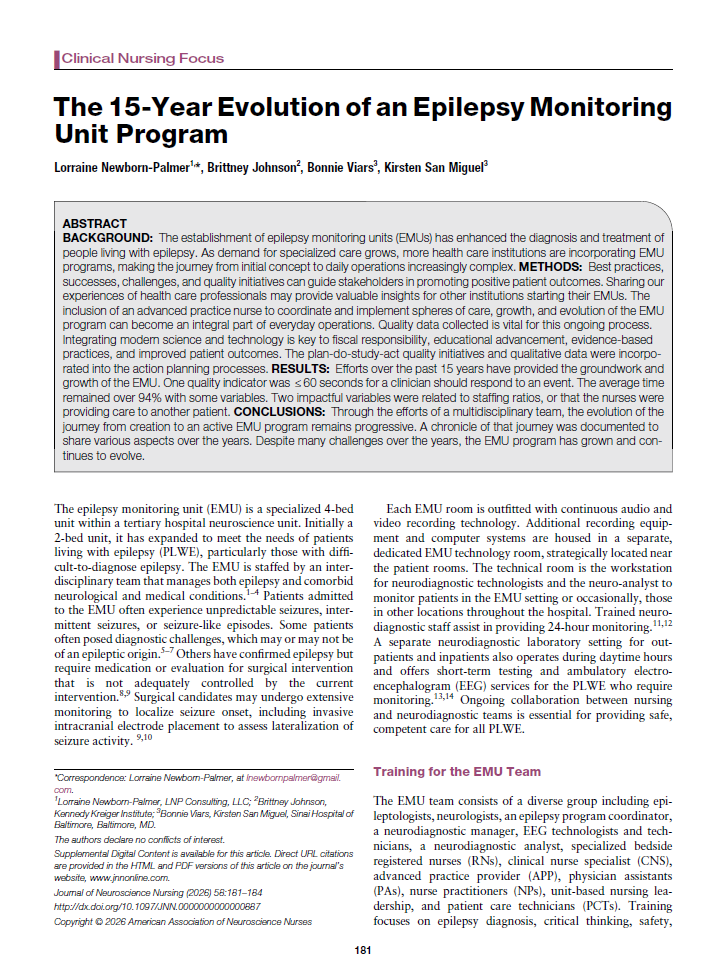
BACKGROUND:

The establishment of epilepsy monitoring units (EMUs) has enhanced the diagnosis and treatment of people living with epilepsy. As demand for specialized care grows, more health care institutions are incorporating EMU programs, making the journey from initial concept to daily operations increasingly complex.

METHODS:

Best practices, successes, challenges, and quality initiatives can guide stakeholders in promoting positive patient outcomes. Sharing our experiences of health care professionals may provide valuable insights for other institutions starting their EMUs. The inclusion of an advanced practice nurse to coordinate and implement spheres of care, growth, and evolution of the EMU program can become an integral part of everyday operations. Quality data collected is vital for this ongoing process. Integrating modern science and technology is key to fiscal responsibility, educational advancement, evidence-based practices, and improved patient outcomes. The plan-do-study-act quality initiatives and qualitative data were incorporated into the action planning processes.

RESULTS:

Efforts over the past 15 years have provided the groundwork and growth of the EMU. One quality indicator was ≤60 seconds for a clinician should respond to an event. The average time remained over 94% with some variables. Two impactful variables were related to staffing ratios, or that the nurses were providing care to another patient.

CONCLUSIONS:

Through the efforts of a multidisciplinary team, the evolution of the journey from creation to an active EMU program remains progressive. A chronicle of that journey was documented to share various aspects over the years. Despite many challenges over the years, the EMU program has grown and continues to evolve.

Share

Modal body text goes here.

FocusOn logo
  • Articles
  • Multimedia
  • Blog
  • Resources
  • About FocusOn
  • Privacy Policy
  • Terms of Use

© 2026 Wolters Kluwer. All right reserved.

Your Privacy

To give you the best possible experience we use cookies and similar technologies. We use data collected through these technologies for various purposes, including to enhance website functionality, remember your preferences, show the most relevant content, and show the most useful ads. You can select your preferences by clicking the link. For more information, please review our Privacy and Cookie Policy.

|
|

Cookie Policy

Information about our use of cookies

Wolters Kluwer ("we" or "us") wants to inform you about the ways we process your personal information. In this Privacy & Cookie Notice we explain what personal information we collect, use and disclose.

Personal information means any data relating to an individual who can be identified, directly or indirectly, based on that information. This may include information such as names, contact details, (online) identification data, online identifiers, or other characteristics specific to that individual.

Read More