FocusOn Neurology
  • Multiple Sclerosis
  • Migraine Research Library
  • LGS & Dravet Syndrome
  • Tardive Dyskinesia
  • Myasthenia Gravis
  • Neurofibromatosis
  • hATTR-PN
  • MDA 2024
  • CIDP Awareness Month
  • Alzheimer's Awareness Month
  • Anticoagulation Reversal Knowledge & Learning Center
  • PNS 2024 Annual Meeting Highlights
  • Parkinson's Disease
  • AES Annual Meeting 2025
  • Epilepsy Knowledge Hub
  • Stroke Awareness Month
  • Multiple Sclerosis
  • Migraine Research Library
  • LGS & Dravet Syndrome
  • Tardive Dyskinesia
  • Myasthenia Gravis
  • Neurofibromatosis
  • hATTR-PN
  • MDA 2024
  • CIDP Awareness Month
  • Alzheimer's Awareness Month
  • Anticoagulation Reversal Knowledge & Learning Center
  • PNS 2024 Annual Meeting Highlights
  • Parkinson's Disease
    • Peer-reviewed articles
    • Supplemental educational content
    • Test Your Knowledge
  • AES Annual Meeting 2025
  • Stroke Awareness Month

Advanced Search

Advanced Search

  • Featured:
  • Epilepsy Knowledge Hub
 

Cerebellar involvement and stimulation in epilepsy

April 2026 | Current Opinion in Neurology
Share:
Epilepsy Awareness Month Peer-Reviewed Articles Page

Read Full Article

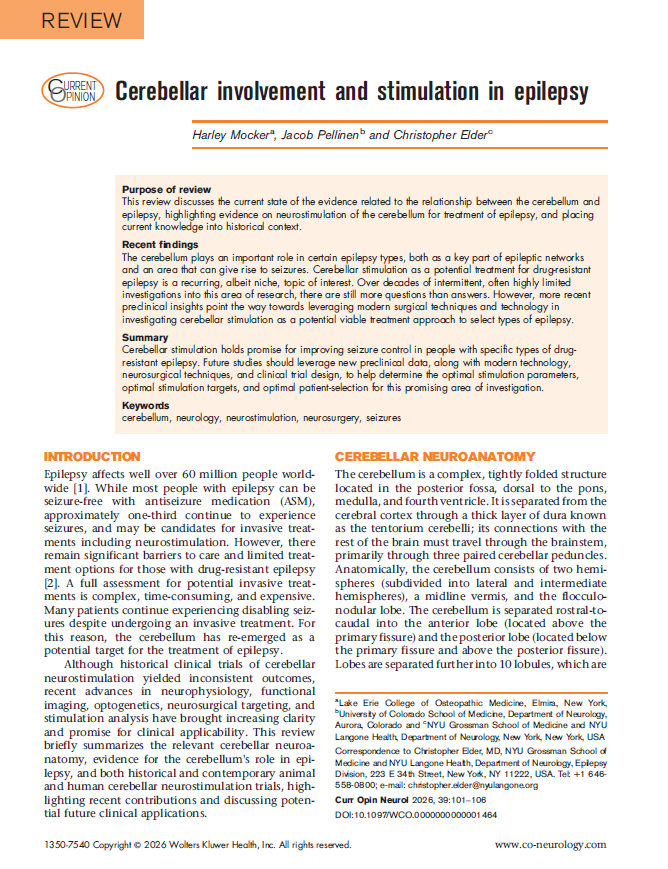
Purpose of review

This review discusses the current state of the evidence related to the relationship between the cerebellum and epilepsy, highlighting evidence on neurostimulation of the cerebellum for treatment of epilepsy, and placing current knowledge into historical context.

Recent findings

The cerebellum plays an important role in certain epilepsy types, both as a key part of epileptic networks and an area that can give rise to seizures. Cerebellar stimulation as a potential treatment for drug-resistant epilepsy is a recurring, albeit niche, topic of interest. Over decades of intermittent, often highly limited investigations into this area of research, there are still more questions than answers. However, more recent preclinical insights point the way towards leveraging modern surgical techniques and technology in investigating cerebellar stimulation as a potential viable treatment approach to select types of epilepsy.

Summary

Cerebellar stimulation holds promise for improving seizure control in people with specific types of drug-resistant epilepsy. Future studies should leverage new preclinical data, along with modern technology, neurosurgical techniques, and clinical trial design, to help determine the optimal stimulation parameters, optimal stimulation targets, and optimal patient-selection for this promising area of investigation.

Share

Modal body text goes here.

FocusOn logo
  • Articles
  • Multimedia
  • Blog
  • Resources
  • About FocusOn
  • Privacy Policy
  • Terms of Use

© 2026 Wolters Kluwer. All right reserved.

Your Privacy

To give you the best possible experience we use cookies and similar technologies. We use data collected through these technologies for various purposes, including to enhance website functionality, remember your preferences, show the most relevant content, and show the most useful ads. You can select your preferences by clicking the link. For more information, please review our Privacy and Cookie Policy.

|
|

Cookie Policy

Information about our use of cookies

Wolters Kluwer ("we" or "us") wants to inform you about the ways we process your personal information. In this Privacy & Cookie Notice we explain what personal information we collect, use and disclose.

Personal information means any data relating to an individual who can be identified, directly or indirectly, based on that information. This may include information such as names, contact details, (online) identification data, online identifiers, or other characteristics specific to that individual.

Read More